Pay in installments of $5.15 with
 ,
,
 and
and

Shipping Estimate
USA
- USA
- CAN
- USA
- CAN
Ships within 48 hours · Estimated delivery Jul 2 - Jul 7
 Promo Codes Available:
For Your Every Summer RSVP, with Code: SUMMER15
Description
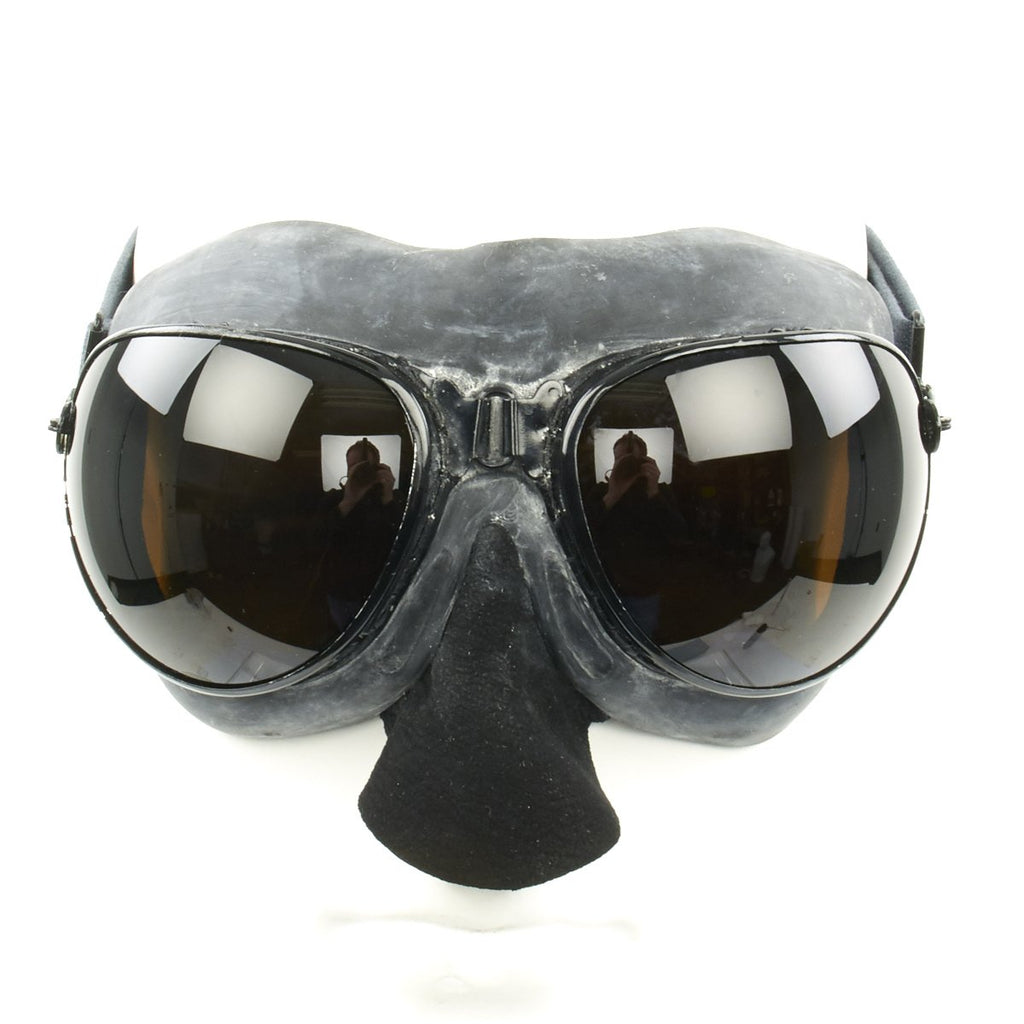
chinese goggles Original Vietnam War North Vietnamese Air Force Chinese Pilot Goggles – International Military AntiquesOriginal Item: Only One Available. These are rare North Vietnamese Air Force Chinese made Pilot's Goggles. This set is offered in NOS mint condition inside the original cardboard box which is dated November 1968, with instruction pamphlet in Chinese and a set of interchangeable smoke tint lenses in addition to the clear lenses. As used by pilot of the North Vietnamese Air Force during the Vietnam War. The first North Vietnamese combat plane was a T 28
The North Vietnamese Air Force (NVAF) received its first jet fighter aircraft, the MiG-17 in February 1964, but they were initially stationed at air bases on Mainland China, while their pilots were being trained. On 3 February 1964, the first fighter regiment No. 921 (Trung đoàn Không quân Tiêm kích 921), aka "Red Star squadron", was formed, and on 6 August it arrived from China in North Vietnam with its MiG-17s.[2] On 7 September, the No. 923 fighter regiment, aka "Yen The Squadron", led by Lt. Col. Nguyen Phuc Trach, was formed. In May 1965, No. 16 bomber company (Đại đội Không quân Ném bom 16) was formed with Il-28 twin engine bombers. Only one Il-28 sortie was flown in 1972 against Royal Laotian forces.
The North Vietnamese Air Force's first jet air-to-air engagement with US aircraft was on 3 April 1965. The NVAF claimed the shooting down of two US Navy F-8 Crusader, which was not confirmed by US sources, although they acknowledged having encountered MiGs. Consequently, 3 April became "North Vietnamese Air Force Day". On 4 April the VPAF (NVAF) scored the first confirmed victories to be acknowledged by both sides. The US fighter community was shocked when relatively slow, post-Korean era MiG-17 fighters shot down advanced F-105 Thunderchief fighters-bombers attacking the Thanh Hóa Bridge. The two downed F-105s were carrying their normal heavy bomb load, and were not able to react to their attackers.
In 1965, the NVAF were supplied with supersonic MiG-21s by the USSR which were used for high speed GCI controlled hit and run intercepts against American air strike groups. The MiG-21 tactics became so effective, that by late 1966, an operation was mounted to especially deal with the MiG-21 threat. Led by Colonel Robin Olds on 2 January 1967, Operation Bolo lured MiG-21s into the air, thinking they were intercepting a F-105 strike group, but instead found a sky full of missile armed F-4 Phantom IIs set for aerial combat. The result was a loss of almost half the inventory of MiG-21 interceptors, at a cost of no US losses. The VPAF (NVAF) stood down for additional training after this setback.
In 1965, the NVAF had only 36 MiG-17s and a similar number of qualified pilots, which increased to 180 MiGs and 72 pilots by 1968. The Americans have at least 200 USAF F-4s and 140 USAF F-105s, plus at least 100 U.S Navy aircraft (F-8s, A-4s and F-4s) which operated from the aircraft carriers in the Gulf of Tonkin, plus scores of other support aircraft. The Americans had a multiple numerical advantage.
Meanwhile, the disappointing performances of US Air Force and US Navy (USN) airmen, even though flying the contemporary advanced aircraft of those times, combined with a legacy of successes from World War II and the Korean War, resulted in a total revamping of aerial combat training for the USN in 1968 (Top Gun school; established 1969). The designs for an entire generation of aircraft, with engineering for optimised daylight air-to-air combat (dog fighting) against both older, as well as for emerging MiG fighters, were being put to the drawing board. US forces could not consistently track low flying MiGs on radar, and were hampered by restrictive rules of engagement (ROE) which required pilots to visually acquire their targets, nullifying much of the advantage of radar guided missiles, which often proved unreliable when used in combat.
The VPAF (NVAF) was a defensive air arm, with the primary mission of defending North Vietnam, and until the last stages of the war, did not conduct air operations into South Vietnam; nor did the NVAF conduct general offensive actions against enemy naval forces off the coast. However it did conduct limited attacks on the opposing naval vessels, notably damaging the United States destroyer USS Higbee in 1972. In a separate incident, MiG-17s that ventured over water were shot down by surface-to-air missiles (SAMs) fired by US warships. The VPAF also conducted an air attack mission against a USAF radar and navigation installation in Laos.
The VPAF (NVAF) did not engage all US sorties. Most US aircraft were destroyed by SA-2 surface-to-air missiles or anti-aircraft artillery (AAA), and in some cases, even small arms. Typically, VPAF MiGs would not engage unless it was to their advantage. Some of the aerial tactics used were similar to Operation Bolo, which lured the NVAF to the fight.
On 24 March 1967, regiments Nos. 921, 923 and 919 were incorporated into the 371st Air Division "Thăng Long" (Sư đoàn Không quân 371). In 1969, No. 925 fighter regiment was formed, flying the Shenyang J-6 (the Chinese-built MiG-19). In 1972 the fourth fighter regiment, No. 927 "Lam Son", was formed.
VPAF flew their interceptors with superb guidance from ground controllers, who positioned the MiGs in perfect ambush battle stations. The MIGs made fast and devastating attacks against US formations from several directions (usually the MiG-17s performed head-on attacks and the MiG-21s attacked from the rear). After shooting down a few American planes and forcing some of the F-105s to drop their bombs prematurely, the MiGs did not wait for retaliation, but disengaged rapidly. This "guerrilla warfare in the air" proved very successful. In December 1966 the MiG-21 pilots of the 921st FR downed 14 F-105s without any losses.
The U.S. Air Force and the US Navy continued to lay down great expectations on the F4 Phantom, assuming that the massive arms, the perfect on-board radar, the highest speed and acceleration properties, coupled with the new tactics would provide "Phantoms" an advantage over the MiGs. But in encounters with lighter VPAF's MiG-21, F-4 began to suffer defeat. From May to December 1966, the US lost 47 aircraft in air battles, destroying only 12 enemy's fighters. From April 1965 to November 1968, in 268 air battles conducted over North Vietnam, VPAF claimed to have shot down 244 US or ARVN's aircraft, and they lost 85 MiGs.
In one of their few offensive air attacks by the VPAF during the entire conflict, on 12 January 1968 a four aircraft formation of Antonov An-2 biplanes was reported flying towards a secret USAF TACAN and radar site in Laos guiding American bombers over Northern Vietnam. Two aircraft flew on to the strike, while the other two split off. As the two continuing An-2s flew over, their crews dropped 120 mm mortar shells as bombs through the aircraft's floor and also strafed their targets with 57 mm rockets from the wing pods. However, as the two aircraft flew back and forth attacking the facility, one aircraft was heavily damaged by ground fire from the facility and crashed. Meanwhile, crew at Lima Site 85 managed to call in a nearby Air America helicopter; a crew member aboard the helicopter armed with an assault rifle fired on the last biplane and caused it to crash.[8] The site was eventually overrun by People's Army of Vietnam commando climbers.
In the spring and summer of 1972, to illumine the theatre of war 360 tactical fighters of the US Air Force and 96 Navy fighter, a great number of which were F4 Phantom of recent modifications, opposed only 71 VPAF's aircraft (including 31 MiG-21).
The culmination of the struggle in the air in the spring of 1972 was 10 May, when the VPAF's aircraft completed 64 sorties, engaging in 15 air battles. VPAF claimed 7 F-4s were shot down (U.S confirmed five F-4s were lost[9]). Those, in turn, managed to shoot down two MiG-21s, three MiG-17s and one MiG-19. On 11 May, two MiG-21, which played the role of "bait", brought the four F-4 to two MiG-21s circling at low altitude. MiGs quickly stormed the "Phantoms" and 3 missiles shot down two F-4. On 18 May, Vietnamese aircraft made 26 sorties in eight air engagements, which cost the 4 F-4 Phantom;Vietnamese fighters on that day did not suffer losses. On 13 June, a MiG-21 unit intercepted a group of F-4, the second pair of MiGs made a missile attack and was hit by two F-4 and did not suffer losses.
Over the course of the air war, between 3 April 1965 and 8 January 1973, each side would ultimately claim favourable kill ratios. A total of 201 air battles took place between American and Vietnamese planes in 1972 sorties. VPAF lost 54 MiGs (including 36 MiG-21s and one MiG-21US) and they claimed 90 U.S aircraft were shot down, including 74 F-4 fighter and two spy RF-4C (MiG-21 shot down 67 enemy aircraft, MiG-17 shot down 11 and MiG-19 shot down 12 enemy aircraft).
US Navy ace Randy Cunningham believed that he shot down a Mig-17 piloted by the mythical "Nguyen Toon" or "Colonel Tomb" while flying his F4 Phantom. However, no research has been able to identify Col. Tomb's existence; Cunningham most likely downed a flight leader of the 923rd Regiment. Legend states Col. Toon had allegedly downed 13 US aircraft during his tenure. Many North Vietnamese pilots were not only skilled but unorthodox, as Cunningham found out after making elementary tactical errors. The resulting dogfight became extended. Cunningham climbed steeply, and the MiG pilot surprised Cunningham by climbing as well. Using his Top Gun training, Cunningham finally forced the MiG out ahead of him and destroyed it. In fact, there wasn't any pilot in VPAF named Nguyễn Toon, he was a fictional character of the American pilots and they often made jokes with the dissertation. An invention of the American pilots, Colonel Toon was a combination of good pilots in Vietnam, like the "solo artist" lonely night bombing in World War II was called Washing Machine Charlie.
There were several times during the war that the US bombing restrictions of North Vietnamese Airfields were lifted. Many VPAF (NVAF) aircraft were destroyed on the ground, and those that were not, were withdrawn to a sanctuary in the north west of the country or in China. In December 1972, the North Vietnamese air defenses nearly exhausted their supply of surface-to-air missiles trying to down the high-flying B-52 raids over the North. The North Vietnamese Air Defense Network was degraded by electronic countermeasures (ECM) and other suppression of Enemy Air Defenses (SEAD) measures. Though the North Vietnamese forces claim over 81 US aircraft as shot down during Operation Linebacker II, (including 34 B-52s, two attributed to the VPAF),[14][dubious – discuss], U.S sources acknowledge only 27 aircraft lost by the Americans (including 15 B-52s).
Within 12 days of the operation "Linebacker-2" (18–29 December), during the eight air battles seven US aircraft (including four F4 Phantom) and three Vietnamese MiG-21 were shot down.
After the negotiated end of American involvement in early 1973, the No. 919 transport air group (Lữ đoàn Không quân vận tải 919), was formed; and equipped with fixed-wing aircraft, as well as helicopters (rotor-wing) in November.
The MiG-21 N. 4324 of the Vietnam People's Air Force. This fighter aircraft, flown by various pilots, was credited for 14 kills during the Vietnam War
During the 1975 Spring Offensive, the bombing of Tan Son Nhut Air Base, the only airstrike conducted by the VPAF, occurred on 28 April 1975, just two days before the Fall of Saigon. The operation was carried out by the VPAF's Quyet Thang Squadron, using captured A-37 aircraft flown by VPAF pilots and RVNAF defectors led by Nguyen Thanh Trung who had bombed the Presidential Palace in Saigon, less than one month earlier before defecting to the north.
During the Vietnam War, NVAF used the MiG-17F, PF (J-5); MiG-19 (J-6), MiG-21F-13, PF, PFM and MF fighters. They claimed to have shot down 266 US aircraft, and US claimed to have shot down or destroyed 204 MiG aircraft and at least six An-2s, of which 196 were confirmed with multiple witnesses/physical evidence (100 MiG-17s, 10 MiG-19s and 86 MiG-21s). However, VPAF admits only 154 MiGs were lost through all causes, including 131 in air combat (63 MiG-17s, 8 MiG-19s and 60 MiG-21s)). Using those figures, total kill ratio would be 1:1.3 to 1:2. With the number of losses to MiGs confirmed by US (121 aircraft shot down and 7 damaged), the kill ratio turns 1.6:1 against the MiGs, or 1.1:1 even accepting the VPAF's figure of only 131 in air combat. However, this ratio does not include the number of ARVN aircraft shot down by the VPAF (one source claims that the VPAF shot down 72 ARVN aircraft.)
Shipping Notes
- Free Standard Shipping on $100+ Orders to the USA.
- Except Preorder products are shipped in 48 hours.
- Delivery to the USA:
- Standard Shipping : 3-10 business days
- If time is of the essence, please consider selecting expedited delivery for faster service.
Exchange/Return Notes
- We offer a 30-day return/exchange service after receiving.
- Final sale items are not eligible for returns or exchanges.
- To process your return/exchange, please contact us at [email protected]
- Please click here for more details>>> Return & Exchange Policy